
The Black Forest surfers of Altensteig

Culture
Experience rafting in the Black Forest up close.

Author: Karoline Kohl
June 25, 2021
At the Monhardt waterworks
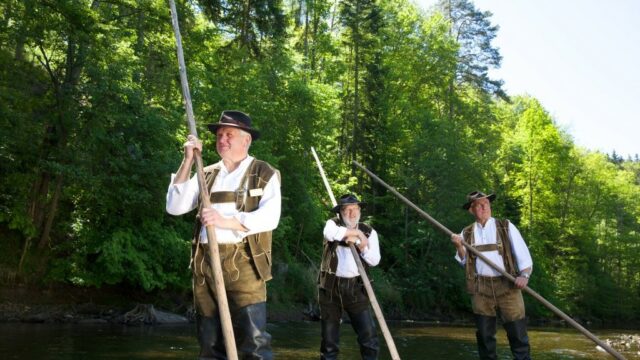
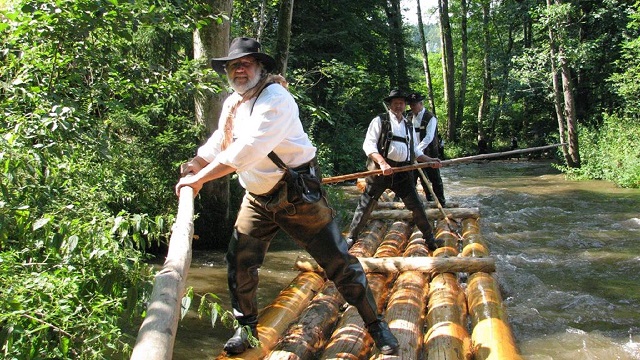
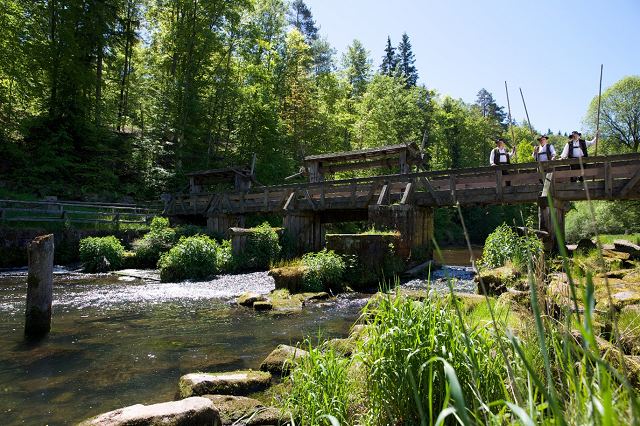
The water of the dammed river roars and rushes. Nagold through the weir of the Monhardt water chamber. "Jockele sperr" Shortly afterwards, the shouts of the rafters ring out, steering the raft made of Black Forest fir trees through the dam.
This historic weir was built according to original plans from 1894. It stands as a monument to the bustling timber trade and transport in the Northern Black Forest, a tradition that lasted for over 250 years . The rustic raft is 60 meters long and consists of interconnected, massive fir trunks.
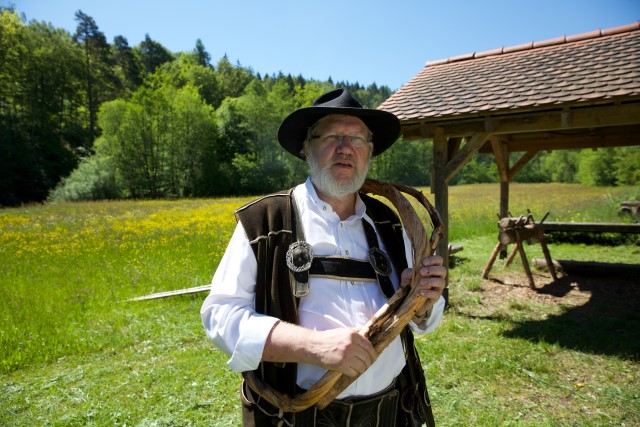
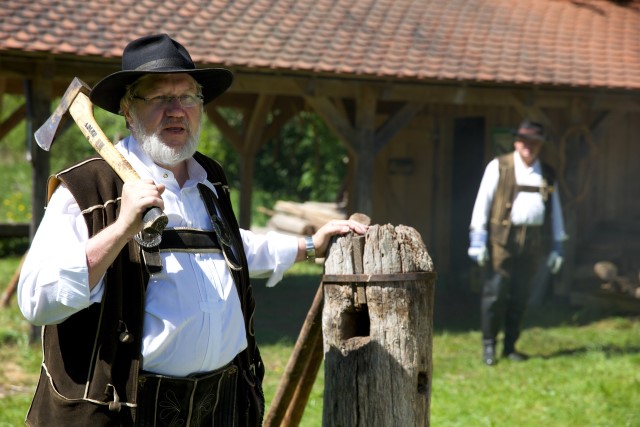
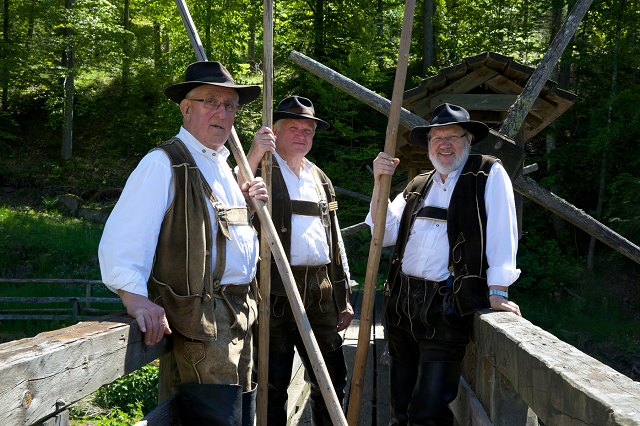
It is controlled by nine Men of the raftsmen's guildTraditionally dressed in white shirts, deerskin breeches, and black felt hats, they glide across the water, spraying around their boots as they skillfully balance on the fir trunks. Using muscle power and wooden poles, they maneuver the raft and surf the waves. Nagold.
International Rafting Festival
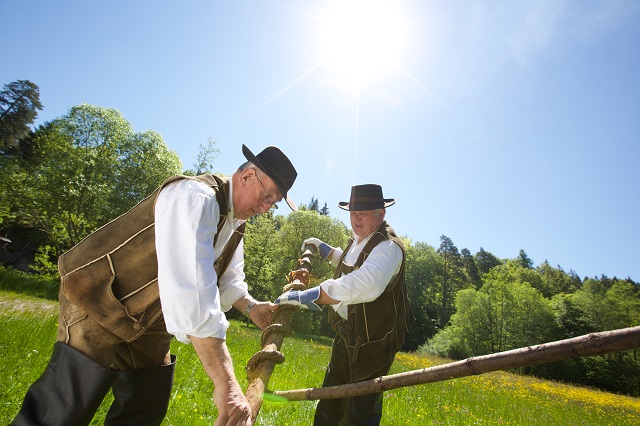
The international rafting festival in Altensteigthe every two years The celebration is a journey back in time. Genuine raftsmen recount anecdotes from their ancestors and tell of the often life-threatening journey on the raft. A blacksmith forges raft hooks from glowing steel, strong men use ropes to pull the "piling ram" upwards, which drives piles into the ground with full force, while others heat the kiln with firebricks, in which fir wood is bent into rings under the heat. The resourcefulness of the Black Forest people is demonstrated by "wiedendrehen," a process in which ropes were twisted from trees to connect the rafts.
For the festival, the weir is opened, and the traditionally dressed rafters maneuver their self-built rafts through the "water channel" of the water chamber. A magnificent sight! Besides this spectacle, the raft festival also offers a fascinating glimpse into the past of old forestry professions and crafts. In various demonstrations, the guild, which has been preserving these traditions for 30 years, shows what it meant in those days to process timber and transport it by raft all the way to Holland.
Fascinated by log rafting - Interview with Martin Spreng, Chairman of the Upper Log Rafting Guild Nagoldtal
Now that's what I call a formative childhood memory...? Growing up in Pforzheim, the very young Martin Spreng saw a picture of a raftsman in a pub in the suburbs. That sparked a passion that wasn't truly awakened until much later, but which today actively contributes to preserving and keeping alive a centuries-old tradition.
EDITOR: You won't think we're being rude if we point out that your childhood days are quite a while ago…
MS: (laughs) No, no problem. In fact, as far as the rafting tradition is concerned, I am a latecomer.
RED.: We have been told that the first “direct” encounter was a painting in a restaurant in your hometown of Pforzheim.
MS: Yes, that really impressed me. But I didn't become truly active until much later.
RED.: And what was the triggering moment?
MS: It was actually rather by chance. In 1993 I had joined Altensteig I was looking at a house. The seller somehow mentioned the term "raftsman". That immediately piqued my interest.
RED.: And that's how the contact with the "Upper Rafting Guild" came about. Nagoldvalley”, which after all also in Altensteig was founded?
MS: Exactly. But at first I was relatively reserved and immediately signaled: I cannot take on an official position.
EDITOR: Well, that proposal didn't last very long…
MS: (laughs) No, you're right. Today I'm not only the chairman of the "Upper Rafting Guild". Nagoldvalley”, but also chairman of the “German Rafting Association”.
RED.: That sounds exciting. Are there big differences between rafting in other countries and in Germany?
MS: Yes, absolutely. It depends heavily on the river and the topography. Even within Germany, there are enormous differences. Rafting in the Black Forest, for example, is very similar to that in Japan.
RED.: A well-known exclamation in this region is "Jockele sperr". Could you please explain that?
MS: This cry was used to signal the raftsman on the last section of a raft, which could be up to 300 meters long, to slow down. Especially in Tübingen, students used the phrase to make fun of the raftsmen on the Neckar River. This sometimes led to quite physical altercations, as the raftsmen were indeed rough, strong men…
EDITOR: …who, of course, didn't let the students get away with that. But fundamentally speaking, braking with a raft is certainly one of the most delicate tasks – and not entirely without risk, is it?
MS: Yes, you have to be very careful that the rafts don't get stuck together or that people don't get trapped underneath or between them. That's why we unfortunately don't have any public raft trips or anything like that here.
RED.: Nevertheless, you and the raftsmen's guild keep the tradition alive in a variety of ways. How can one imagine the activities of such an association?
MS: Actually, it's very diverse. We want to research the lives of the rafters and keep their traditions alive. After all, this craft provided a livelihood for many people in earlier times. Besides the history, the technology of rafting is also very fascinating. You can experience this live at the Rafting Festival, which takes place every two years.
RED.: Apart from the rafting festival, how and where else can one get closer to the rafting tradition?
MS: We participate in many historical festivals, such as the parade at the Cannstatter Wasen. We also regularly offer guided tours, which are open to everyone. These can be either public tours or private tours by appointment. For smaller groups, such as scouts, we also organize three-day courses where participants build and sail their own small raft. Our guests come from Germany and abroad. We even hosted the Dutch ambassador once.
RED.: That fits quite well, doesn't it?
MS: However, after all, Holland used to be the largest buyer of domestic wood – Amsterdam's train station, for example, stands on 2.600 Black Forest fir trees.
EDITOR: Still? Shouldn't they be replaced after so many years – or centuries?
MS: No, not really. The logs just need to be submerged deep enough in the water, then they won't rot. Today you'd probably say: genuine Black Forest quality!
RED.: Mr. Spreng, thank you for the interview.